Power outages don’t wait for convenient times. When the grid fails, you need a generator that keeps your home running without breaking your budget or wasting fuel. Here’s how to size your backup power correctly.
Calculate Your Power Needs
Start by listing the essential appliances you want to run during an outage. Your refrigerator typically uses 700-800 watts, while your freezer needs another 600-700 watts. A sump pump draws 800-1200 watts, and your furnace blower requires 600-900 watts.
Don’t forget lighting and phone chargers—budget 200-300 watts for basic needs. Add these numbers to get your baseline requirement.
Pro tip: Check the yellow energy labels on your appliances for exact wattage ratings. These labels give you accurate numbers instead of estimates.
Account for Starting Surge
Electric motors need 2-3 times their running wattage when they start up. Your refrigerator might run on 700 watts but requires 2,100 watts to start. This surge power matters because your generator must handle these brief spikes without overloading.
Calculate both your running watts (total of all appliances) and starting watts (highest starting requirement plus other running loads). Your generator must exceed both numbers.
Choose Your Generator Size
For most homes, these ranges work well:
5,000-7,500 watts: Powers essential circuits including refrigerator, freezer, a few lights, and your furnace. This size works for basic emergency backup in smaller homes.
7,500-10,000 watts: Handles essentials plus a window AC unit or well pump. Most average-sized homes operate comfortably at this level during outages.
10,000-15,000 watts: Runs most household circuits with room for larger appliances. You can power your central AC, electric water heater, and still have capacity for other needs.
Whole-house (20,000+ watts): Powers everything simultaneously, just like normal operation. These systems cost more but deliver complete peace of mind.
Consider Your Transfer Switch
Your transfer switch determines which circuits receive generator power. A manual transfer switch costs less but requires you to select circuits. An automatic transfer switch costs more upfront but starts your generator and switches circuits without your intervention.
Match your generator size to your transfer switch capacity. Installing a 10,000-watt generator with a transfer switch that only handles 6,000 watts wastes money and capability.
Factor in Fuel Efficiency
Larger generators burn more fuel per hour, even when lightly loaded. A 15,000-watt generator running at 30% capacity wastes fuel compared to an 8,000-watt unit running at 60% capacity.
Right-sizing saves you money every time you run the generator. Calculate your actual needs rather than overbuying “just in case.”
Get Professional Installation
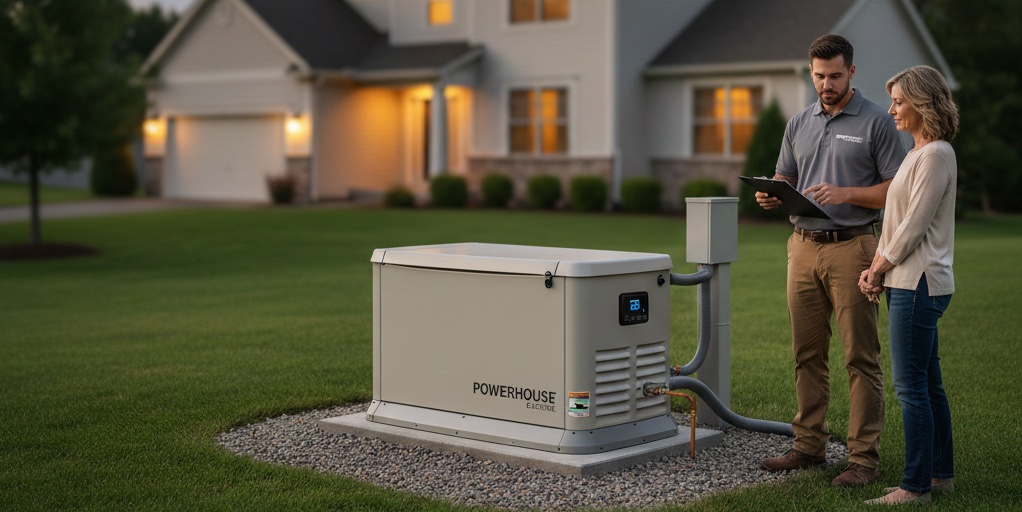
Licensed electricians ensure your generator meets local codes, installs safely, and operates correctly. We properly ground the system, install the transfer switch according to regulations, and test everything before we leave.
Improper installation creates fire hazards, electrocution risks, and potential carbon monoxide dangers. The money you save with DIY installation isn’t worth these risks.
A correctly sized generator delivers reliable backup power for years. Calculate your needs, choose appropriate capacity, and hire a licensed electrician to install it properly.