
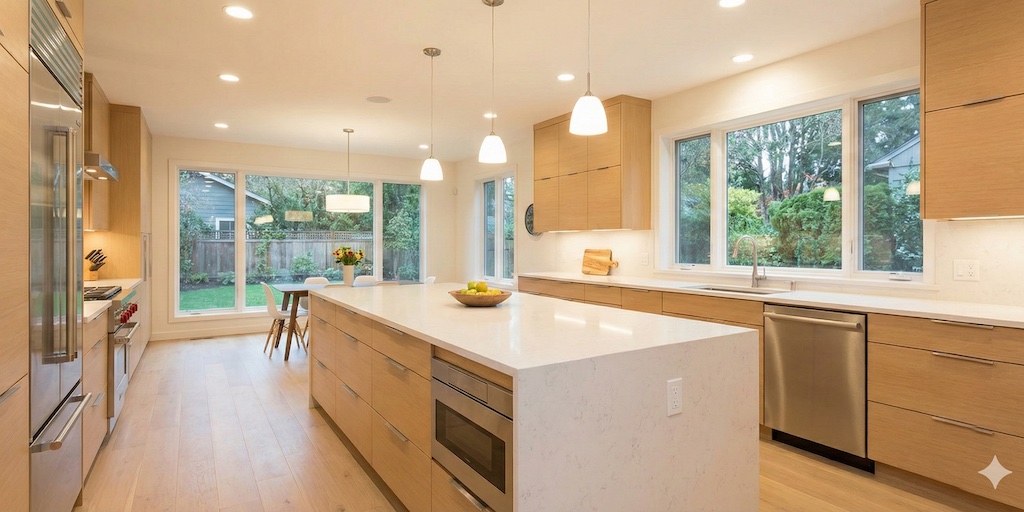
Your kitchen demands excellent lighting. You prep food, cook meals, clean dishes, and gather with family in this space. Poor lighting creates shadows where you work, strains your eyes, and makes your kitchen feel cramped. Here’s how to light your kitchen correctly.
Layer Your Lighting
Professional kitchen lighting uses three layers that work together.
Ambient lighting provides overall illumination. Recessed ceiling lights or flush-mount fixtures spread light evenly across the room. Install these fixtures on a dimmer so you can adjust brightness for different activities.
Task lighting focuses on work areas. Under-cabinet LED strips illuminate countertops where you chop vegetables and read recipes. Pendant lights over islands provide focused light for food prep and casual dining.
Accent lighting adds depth and visual interest. LED strips inside glass-front cabinets showcase dishes. Toe-kick lighting creates a floating effect and helps you navigate safely at night.
Focus on Work Surfaces
You need bright, shadow-free light where you work. Under-cabinet fixtures should sit at the front of the cabinet, not the back. This placement prevents shadows from your body when you stand at the counter.
Install task lighting above your sink—a small pendant or recessed light directly overhead eliminates shadows in the basin. Your range hood should include built-in lighting that illuminates your cooktop effectively.
Choose the Right Color Temperature
Color temperature affects how your kitchen feels and how accurately you see food colors. Measured in Kelvin (K), this specification matters for kitchen work.
2700-3000K (warm white): Creates a cozy atmosphere but may distort food colors slightly. Use this temperature for ambient and accent lighting.
3500-4100K (neutral white): Balances warmth with clarity. This range works well for general kitchen lighting and task areas.
5000K+ (daylight): Renders colors most accurately but feels clinical. Reserve this temperature for specific task lighting where color accuracy matters.
Keep color temperatures consistent within each lighting layer. Mixing warm and cool lights in the same space creates an unpleasant, disjointed appearance.
Calculate Your Lighting Needs
Kitchens require 50-75 lumens per square foot for ambient lighting. A 150-square-foot kitchen needs 7,500-11,250 lumens total from your ceiling fixtures.
Task areas demand 75-100 lumens per square foot. Your 6-foot countertop (12 square feet) needs 900-1,200 lumens from under-cabinet lighting.
Modern LED bulbs list lumens on the package. Add up your bulb lumens to verify you meet these minimums.
Plan for Safety and Code Compliance
Kitchen electrical work must meet National Electrical Code requirements. You need GFCI protection for outlets near water sources. Recessed lights require IC (insulation contact) ratings if they contact insulation in your ceiling.
Pendant lights over islands must hang 30-36 inches above the counter surface. This height provides adequate light without blocking sightlines or creating head-bumping hazards.
Hire a Licensed Electrician
Kitchen lighting installation involves running new circuits, installing switches, and working in tight spaces. Licensed electricians ensure proper wire sizing, secure connections, and code-compliant installations.
We also help you position fixtures for optimal light coverage and minimal shadows. Our experience prevents costly mistakes like poorly placed recessed lights or inadequate circuit capacity.
Quality kitchen lighting transforms how you use this essential space. Plan your layers carefully, choose appropriate fixtures, and trust a professional to install everything safely.